Winnipeg's General Strike by Michael DuPuis
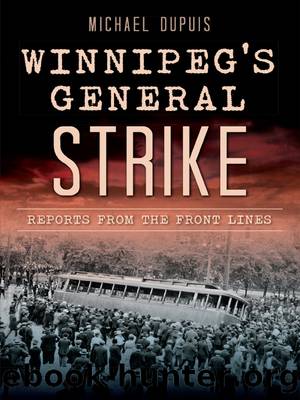
Author:Michael DuPuis
Language: eng
Format: epub
Publisher: The History Press
Published: 2014-10-15T00:00:00+00:00
Norris addressing anti-strike Loyalist veterans, June 4. Note the reporter in front of Gray writing on a notepad. Courtesy of Archives of Manitoba N12297, Winnipeg Strike 6.
Anti-strike Loyalists veterans prepare to march on June 4. Courtesy of Archives of Manitoba N12295, Winnipeg Strike 4.
Anti-strike Loyalists veteransâ demonstration at City Hall, June 4. Courtesy of Archives of Manitoba N2737, Foote 1671.
By the authority vested in me, I do hereby order that all persons do refrain from forming or taking part in any parades or congregating in crowds or upon the streets of the City of Winnipeg, and do hereby request of all law-abiding citizens the full compliance with this proclamation.
On June 6, the Canadian government introduced amendments to the Immigration Act permitting deportation without trial of anyone not born in Canada who was accused of sedition. The Act to Amend the Immigration Act, which took only forty-five minutes to be given three readings in the House of Commons and Senate, was targeted against the British-born leaders of the Winnipeg strike. The following day, Mayor Gray addressed a large crowd of strikers and veterans at Victoria Park, which had been renamed Soldiersâ Parliament, and several returned soldiers were signed as special constables. On June 8, former Winnipeg minister James S. Woodsworth arrived in Winnipeg and that evening spoke at the Sunday Labor Church service at Victoria Park to ten thousand people.
James Hareâs photo story in Leslieâs, titled âCanadaâs Fight Against Bolshevism,â provided a gallery of twelve photographs. Two side-by-side pictures taken on June 3 showed a large crowd of pro-strike veterans assembled in front of the Industrial Bureau. The first photograph was captioned, âStrikers about to tear down sign from the Board of Trade doorway in the Industrial Building, Winnipeg âHeadquarters of Citizensâ Committee of One Thousand.â Though small fights have occurred regularly, there has been no mob violence except in the matter of destroying signs, newspapers, etc.â The second photograph was captioned, âThe same doorway a few moments later after the sign was torn down. This demonstration followed a visit to the Parliament buildings to demand new legislation favorable to the strikers. The general strike began in May over a trivial labor dispute, but it developed into a matter of âBolsheviksâ vs. âbourgeois.ââ
In contrast, three of Hareâs photographs shot on June 4 featured anti-strike returned soldiers. One taken at the corner of Main Street and Broadway Avenue showed a parade of veterans and was captioned, âThe Canadian general strike has settled down to the bitterest fight between union labor and a community that the western world has seen. Canada looks upon the strike as a finish fight against the soviet idea in government.â A second featured the same veterans in front of City Hall with signs reading, âDown with Bolshevism, We Will Maintain Constituted Authority, Law & Orderâ and âDeport the Undesirable Alien.â A third with Premier Norris addressing anti-strike servicemen near the legislature was captioned, âPremier Norris denounced the strikersâ parade because of its leaders, who advocated Bolshevism. He refused
Download
This site does not store any files on its server. We only index and link to content provided by other sites. Please contact the content providers to delete copyright contents if any and email us, we'll remove relevant links or contents immediately.
The Vikings: Conquering England, France, and Ireland by Wernick Robert(84379)
Ali Pasha, Lion of Ioannina by Eugenia Russell & Eugenia Russell(40318)
The Conquerors (The Winning of America Series Book 3) by Eckert Allan W(37983)
The Vikings: Discoverers of a New World by Wernick Robert(37006)
Cecilia; Or, Memoirs of an Heiress — Volume 1 by Fanny Burney(32636)
Cecilia; Or, Memoirs of an Heiress — Volume 2 by Fanny Burney(32010)
Cecilia; Or, Memoirs of an Heiress — Volume 3 by Fanny Burney(31996)
Empire of the Sikhs by Patwant Singh(23135)
The Secret History by Donna Tartt(19294)
Hans Sturm: A Soldier's Odyssey on the Eastern Front by Gordon Williamson(18649)
Cat's cradle by Kurt Vonnegut(15441)
Pimp by Iceberg Slim(14665)
Sapiens: A Brief History of Humankind by Yuval Noah Harari(14459)
Norse Mythology by Gaiman Neil(13457)
Talking to Strangers by Malcolm Gladwell(13439)
Leonardo da Vinci by Walter Isaacson(13411)
4 3 2 1: A Novel by Paul Auster(12511)
Underground: A Human History of the Worlds Beneath Our Feet by Will Hunt(12145)
The Radium Girls by Kate Moore(12093)
